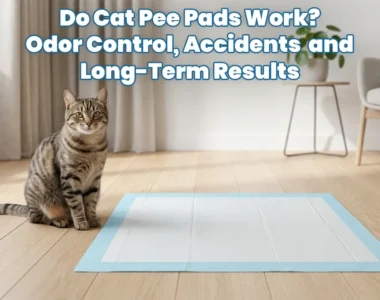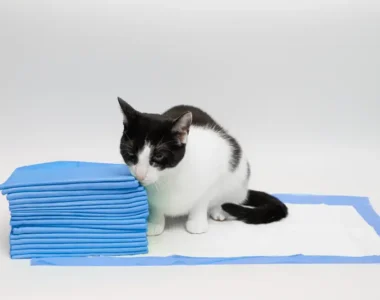

Cat pee pads spark more conversation among vets and animal behaviorists than you’d expect for something so straightforward. Some reach for them without hesitation. Others want you to slow down first.
If your cat is going outside the litter box, a pee pad can feel like the obvious solution, and sometimes it really is. But knowing when to use one, and why, makes a bigger difference than most people realize. Here’s what the professionals actually think.
What Vets Actually Recommend for Urination Issues
The first thing most vets will tell you: any sudden change in bathroom behavior is a medical question until you can prove otherwise. Once medical issues are ruled out or treated, vets tend to recommend pee pads in a few specific situations:
- Senior cats with arthritis or reduced mobility: high-sided litter boxes become a real obstacle as cats age. A pad placed somewhere accessible takes that barrier away entirely.
- Post-surgical recovery: a cat who needs to rest and stay in a small space still needs somewhere clean and dry to go.
- Cats with incontinence: those that leak urine involuntarily as a result of neurological problems, spine issues, or old age are much more at ease if there’s absorbent material near them.
- Travel: A pee pad in a carrier to deal with the stress-related pee accidents that occur while traveling to the vet or on long trips.
What vets are consistent about is that pee pads support the litter box; they don’t replace it. Most cats have a deep instinct to dig and cover when they eliminate. A flat pad doesn’t give them that. Swapping the box out entirely for pads tends to create more behavioral tension, not less.
What Animal Behaviorists See That Owners Often Miss
Behaviorists come at this differently. They are less focused on what’s happening in the body and more interested in what’s happening in the cat’s environment, and in their head.
A few things they pick up on that most people walk straight past:
- Box location stress — a litter box next to a noisy appliance, a vent, or in a busy hallway can make a cat feel too exposed to use it comfortably. Cats are private creatures. They need to feel safe when they’re vulnerable.
- Not enough boxes — the standard advice is one box per cat, plus one more. In multi-cat homes, shared boxes create social tension. One cat dominates; another learns to go elsewhere.
- Texture preference — some cats just prefer smooth, flat surfaces to granular litter. That’s why they go for carpet, tile, or a pile of laundry. A pee pad actually fits that preference and can work as a redirection tool.
- Scent memory — once a cat has urinated somewhere and the smell isn’t fully eliminated with an enzymatic cleaner, they’ll come back. The scent tells them it’s an approved spot. Placing a pad there while you work on retraining gives the behavior somewhere to land in the meantime.
When behaviorists do recommend pee pads, it’s usually one piece of a larger plan, not the whole answer on its own.
Avoid These Pitfalls if You’re Using Cat Pee Pads
Even in the right situations, how you use pee pads matters. A few mistakes that tend to backfire:
- Using them instead of a litter box, without a medical reason. The instinct to dig and cover is hardwired. Take away the only surface that allows for it, and you create frustration that shows up in other ways.
- Not changing them often enough. Cats are clean animals. A wet, smelly pad is going to be refused on the next visit, which defeats the whole point. Change them promptly, ideally after each use.
- Treating the pad as the solution. A cat who keeps missing the box is communicating something. Putting down more pads manages the mess, but it doesn’t tell you what’s driving the behavior. That part still needs attention.
- Placing them in the open. Cats feel exposed when they eliminate. A pad in the middle of the room may be ignored entirely. Tuck them into corners, against walls, near furniture, somewhere that feels sheltered.
- Cleaning nearby areas with ammonia-based products. Ammonia smells like urine to a cat. Using it anywhere near where you’ve placed a pad can actually pull them back to that spot repeatedly, which is the opposite of what you want.
What the Experts Agree On About Cat Pee Pads
Neither vets nor behaviorists give a simple thumbs up or thumbs down on cat pee pads. What they both emphasize, just from different directions, is that the reason your cat is behaving the way they are matters more than any product you put on the floor.
Pee pads are a very helpful, caring solution for senior cats, cats recovering from surgery, cats with incontinence, or when cats are in transit. They safeguard your home, aid in cleanliness, and eliminate obstructions that may otherwise make an already challenging scenario even worse.
If your cat is avoiding the litter box as a means of communicating a problem, a litter pad is a bridge until you determine what the issue is. Combine this with a veterinary checkup, a fair evaluation of the environment, and a bit of patience, and it can keep things afloat until you can get to the vet.
The best cat pee pads are absorbent, leak-proof, and can be used for short-term or long-term use in sizes that suit them. If you’re going through cat pee pads regularly, for a senior cat, a multi-cat household, or an ongoing management situation, having a reliable supply from bulk-price means you’re not caught scrambling when you need one most.
They’re not magic. But for the right cat, in the right situation, used with some actual understanding of why, they work.
FAQs
Are cat pee pads the same as puppy pads?
Pretty much, yes. Both are made in a similar fashion, with the absorbent material in layers, a waterproof backing, and a fast-drying top layer. There are a few pads made specifically for cats that may be sized slightly differently, or may even be scent-free, as cats don’t like some puppy pads. Some cat owners have no problem whatsoever using puppy pads. Simply ensure it’s the correct size and see if it contains scent attractants on the packaging.
Can pee pads fully replace a litter box for a cat?
For most healthy cats, no. Digging and covering is not a learned behavior; it’s instinct, and it’s deeply rooted. A flat pad doesn’t allow for any of that, which can leave a cat frustrated or searching for a soft surface elsewhere to satisfy the urge. For cats with incontinence or serious mobility issues, a pad may become the main option out of necessity.
How often should I change a cat pee pad?
As often as your cat requires, which usually means after each use, or once a day at a minimum. A pad that’s been sitting wet too long will be rejected. Cats are clean by nature and they notice. If you have a senior cat with incontinence going through several pads a day, buying in bulk is the only way to keep up without constantly restocking.
Is it safe if my cat chews on or plays with the cat pee pad?
Overall, the materials used are non-toxic, but the pads are not intended to be consumed. There is a concern that some pads have a super absorbent polymer in the absorbent core that can cause them to expand if swallowed. When your cat is known for shredding and/or mouthing, be sure to watch her around pee pads and consider a more durable pad that won’t be easily chewed or shredded. Take the pad away when the cat is not using it if he is actively chewing some, and redirect the chewing.
Where is the best place to put a cat pee pad in the house?
Wherever your cat is already going. That’s the honest answer. If they keep choosing the corner of the bedroom or a spot by the hallway, place the pad there instead of fighting the location. You can gradually move the pad toward the litter box over time if that’s the goal. And to avoid open, exposed spots, cats want privacy when they are eliminated, so corners and wall-adjacent spots work far better than the middle of a room.
Want to cut your pet supply expenses without sacrificing quality? Check out our cat pee pads at Bulk-Price today. Give your heavy chewer a treat they love at a price you will love even more!