Plastic zip bags are cheap, familiar, and slowly becoming a liability for food businesses that haven’t planned ahead. Between city-level plastic restrictions, customers who check packaging before they order, and film suppliers scaling back production, cafés are switching to compostable sandwich bags faster than most owners anticipated a year ago. It’s the reason Bulk-Price stocks compostable sandwich bags suited to a working café counter, but before placing a bulk order, it is worth knowing what changes in daily prep, storage, and service once those bags are behind the counter.
Why Cafés Are Making the Switch Now
The pressure isn’t only environmental optics anymore. A few practical forces are converging at once:
- Local regulations. More cities and states are tightening rules around single-use food-service packaging, making it worthwhile for cafés to review their packaging choices.
- Customer perception. Sustainable packaging can be used to promote a café’s environmental values and contribute to a positive customer experience.
- Supply planning. For companies that still use traditional plastic packaging, this might be a good time to explore alternative packaging solutions, due to availability or regulatory issues.
- Waste management. Acceptance and possible cost savings depend on the municipality; some have local waste-hauling contracts and/or composting programs that can accept certified compostable packaging along with food scraps.
Certified compostable packaging may be collected with the food waste in some cities and towns, depending on local composting and waste collection services, and may cost less than non-compostable packaging, depending on local composting programs and waste collection service contracts.
None of this means overhauling an entire packaging line overnight. Sandwich bags are usually the easiest place to start: high turnover, low cost per unit, and a swap that doesn’t touch the menu, the POS system, or staff training in any meaningful way.
What Makes a Sandwich Bag Compostable?
This is where a lot of confusion creeps in, and it’s worth clearing up before a case of anything gets ordered. Compostable is not biodegradable, and it’s not the same as recyclable, which are three different words with three different meanings for a composting facility.
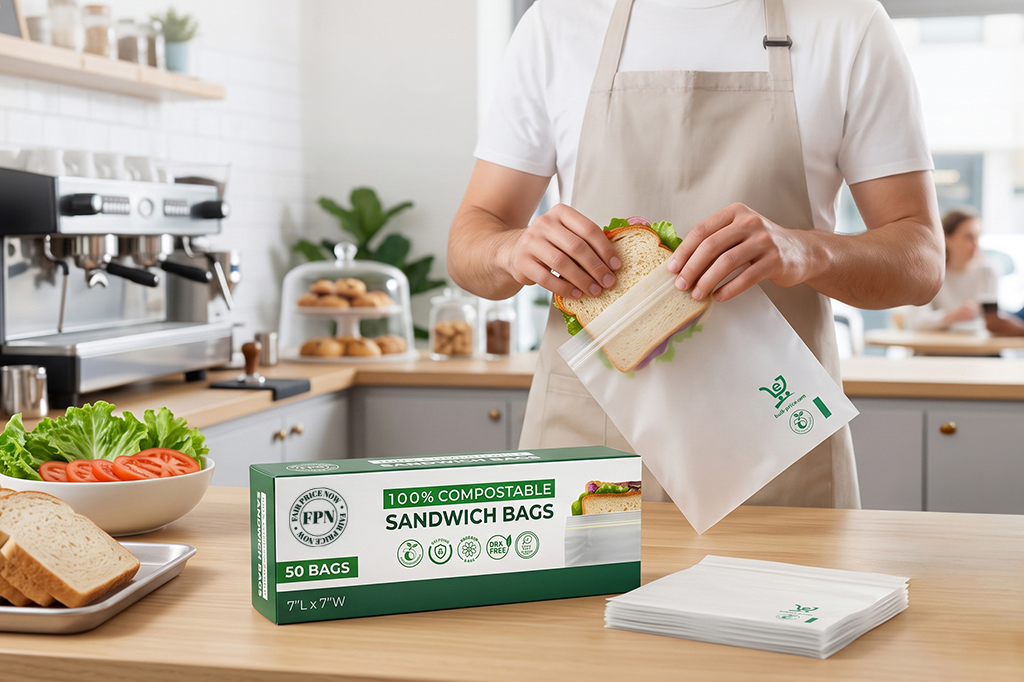
Composting sandwich bags are constructed from plant-based material, most often derived from corn (PLA and PBAT) instead of petroleum. They decompose into water, carbon dioxide, and organic matter, leaving behind no microplastics. Bulk-Price’s compostable sandwich bags are 100% plant-based, BPA-free and non-GMO, with a secure zip-lock seal, so switching doesn’t cost a café anything in leak protection or shelf presentation. They’re also freeze- safe, which is not the case with most paper-based compostable items that tend to fall apart in the freezer.
Choosing Between Paper and Plant-Based Zip-Lock Bags
Cafés typically land on one of two formats, and each one has a different job to do.
| Feature | Plant-based zip-lock bags | Compostable paper bags |
|---|---|---|
| Best for | Wet or moist sandwiches, wraps, cold items | Dry sandwiches, pastries, baked goods |
| Seal type | Zip-lock, resealable | Fold-top or sticker seal |
| Leak resistance | High | Low to moderate |
| Freezer safe | Yes | No |
| Contents visibility | Clear | Opaque |
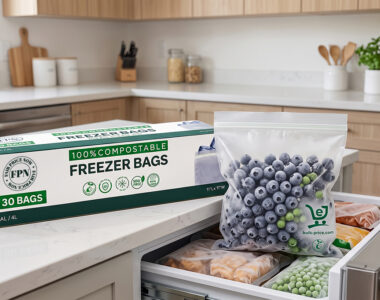
A deli slinging dressed sandwiches and cold cuts gets more out of a zip-lock format because the seal does the work a fold-top bag can’t. A bakery-style café doing dry pastries or grab-and-go muffins can usually get by with paper instead. Plenty of operations end up stocking both and using each where it actually fits, rather than forcing one format to cover everything on the counter. For anything headed to the freezer in bulk, Bulk-Price’s compostable freezer bags are built specifically for that use case rather than stretching a standard sandwich bag past what it’s meant to do.
Bulk Ordering: Storage, Cost, and What to Watch For
Buying compostable bags in bulk brings the per-unit cost down considerably compared to retail boxes, but plant-based film behaves a little differently than plastic once it’s sitting in a stockroom, and that’s the part most first-time buyers overlook.
- Storage conditions matter more than they did with plastic. Store cases in a cool, dry area and out of direct air and heat from ovens and dishwashers.
- Don’t overbuy for a slow season. Compostable film has a shelf life. A year’s worth of inventory baking in a hot back room isn’t a great trade-off, even at a lower unit price.
- Check counts before comparing prices across suppliers. A 50-count box next to a 200-count case can make one supplier look cheaper than it actually is per bag.
- Factor in reorder timing. Bulk-Price ships across the USA with dependable turnaround, which matters for a café that can’t afford to run short mid-lunch-rush.
Buying directly through Bulk-Price also skips the extra layer of cost that comes with ordering through a foodservice distributor, and it puts a café in direct contact with a supplier that stocks wholesale compostable sandwich bags in counts built for actual daily volume: 50-count and 200-count options, not the smaller boxes designed for a home kitchen.
That consistency in sizing, seal quality, and material sourcing is what separates a supplier a café can build a reorder schedule around from one that’s just filling a one-time order. Cafés running a broader eco-friendly setup can pair the bags with Bulk-Price’s compostable tableware line for takeout plates and bowls sourced from the same catalog, which keeps packaging consistent across the whole counter.
FAQs
Are compostable sandwich bags actually leak-proof enough for a busy café?
Yes, provided the bag has a proper zip-lock seal. Bulk-Price’s version is built to hold moist fillings without splitting, which is the main durability complaint with lower-grade compostable film on the market.
Will compostable bags cost more than plastic long-term?
Per-unit cost narrows considerably once buying in bulk. Some cafés also offset part of the difference by paying lower waste-hauling fees when municipal composting programs accept certified compostable packaging.
Can these bags go in the freezer for prepped sandwiches?
Yes. Bulk-Price’s compostable sandwich bags are freezer safe, which makes them workable for meal-prep-style café operations, not just same-day counter service.
Do compostable bags need a special composting facility, or can they go in regular trash?
They’re designed for composting facilities, whether municipal or home-based where available. Tossed into regular landfill trash, they won’t break down meaningfully faster than plastic, since most landfills are effectively airtight.
What size should a café order for standard sandwiches versus wraps?
Standard sandwich-bag dimensions cover most deli sandwiches and wraps without issue. Larger or double-stacked sandwiches may need a quick size check against the product page before committing to a full case.