Ask a handful of kitchen managers around Spring what they actually worry about with packaging, and you will see that falling short of supplies mid-week comes up more than anything to do with sustainability. Soup doesn’t really have an off-season here. Tortilla soup, gumbo, pho, even a basic chicken noodle special, all of it moves steadily from January through August, and the bowl underneath it has to show up every week, not just when a distributor happens to have stock.
We’ve watched enough orders go out the door to know which sizes get reordered and which sit in a stockroom collecting dust. This piece covers what matters when buying compostable soup bowls wholesale for a Spring, TX restaurant, what the material differences mean in actual service, and how to size an order so you’re not guessing every quarter.
Bagasse, PLA, and Bamboo: What Repeat Orders Tell You
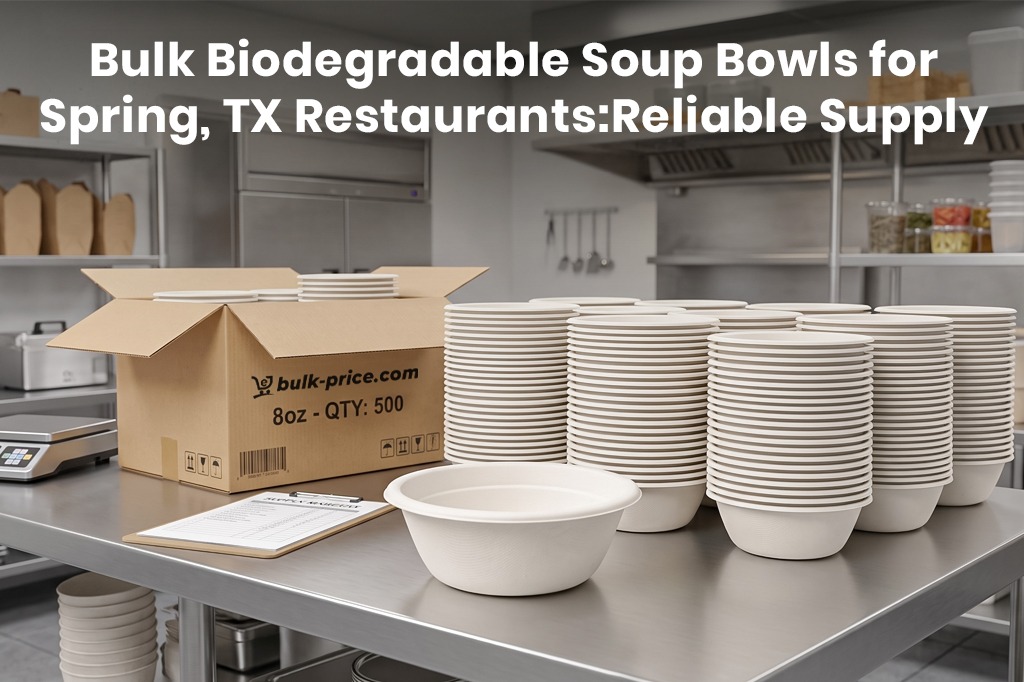
Sugarcane bagasse has more or less become the default for compostable soup bowls, and it earned that spot honestly. It’s the fibrous leftover from sugar processing, not a crop grown specifically for packaging, which already puts it ahead on the sustainability math. It’s compressed into a bowl shape and doesn’t need a plastic liner to stay intact when exposed to hot liquids, wicks oil and moisture, and doesn’t warp on the rim when placed in the microwave.
Foam is still around because it’s cheap and insulates well. But the regulatory direction is obvious, and betting your packaging line on a material that’s already banned in dozens of cities feels like a short-term decision with a long-term cost. PLA-lined paper bowls sit in the middle. They look like a reasonable upgrade until you put real heat behind them; the lining tends to soften over time, and most PLA only breaks down in an industrial composting facility, which isn’t exactly common in this part of Texas.
|
Material |
Heat Performance |
Leak Resistance |
Compost Path |
Cost at Volume |
|
Bagasse (sugarcane) |
Microwave-safe, holds up under hot liquid |
Naturally oil and moisture resistant |
Breaks down in 60–90 days, widely accepted |
Low |
|
PLA-lined paper |
Softens with prolonged heat exposure |
Decent, but the liner can separate at the seam |
Industrial composting facility only |
Moderate |
|
Bamboo fiber |
Solid heat tolerance |
Solid |
Varies by local facility |
Higher |
|
Foam (EPS) |
Strong insulation |
Solid |
Not compostable, banned in many cities |
Very low upfront, rising regulatory exposure |
Most suppliers skip a comparison like this, mostly because it doesn’t favor everything in their catalog. For soup specifically, bagasse wins on the two things that matter most in actual service: it tolerates heat and resists liquid without leaning on a plastic coating to do the work.
Finding a Restaurant Soup Bowl Supplier Worth Sticking With
A supplier worth building a relationship with offers more than a competitive per-unit price, though that matters too. Consistent stock across every size in your rotation is the real test, since running dry mid-week forces a kitchen into an expensive, last-minute substitute that rarely matches what’s already on the menu. Free shipping on qualifying orders keeps the landed cost predictable from one order to the next, and the ability to test a free sample before committing to a full case takes most of the risk out of switching.
Bulk Price stocks compostable sugarcane bagasse bowls in the sizes restaurants in Spring, TX actually reorder, with bulk counts and pricing that step down as volume goes up. The full biodegradable bowls collection is worth browsing side by side rather than ordering a single size, since it’s a faster way to plan inventory than calling two or three local stores to see if one has what you need.
One Supplier for All Your Sustainable Packaging Needs
Soup bowls rarely stay an isolated purchase for long. Once a kitchen switches over, plates, takeout containers, and bags usually follow within a season or two, partly because customers notice when a restaurant goes halfway, and partly because managing one supplier is just simpler than juggling three.
If you’re in that direction, the compostable plates and biodegradable food storage containers at Bulk Price match, and the wide selection of eco-friendly restaurant supplies covers most of what a kitchen would otherwise buy in pieces.
FAQs
What are biodegradable soup bowls made of?
The majority are made from sugarcane bagasse, which is the fibrous pulp produced after sugarcane is processed to extract the sugar. Some others are made of bamboo fibre or paper coated with plant-derived PLA, but bagasse tends to do better with hot spicy soups without the need for a plastic liner.
What’s the difference between biodegradable and compostable packaging?
Biodegradable only implies that the material will disintegrate naturally over a period of time, and says nothing about the time period or the conditions. Compostable indicates it decomposes within a specific period of time, typically in a commercial composting facility, into a product that is not harmful to the soil. Bagasse bowls are considered to be both, which is one of the reasons why they have become the standard.
Are compostable soup bowls safe for hot soup?
Yes, as long as the material is appropriate. Bagasse bowls are microwave-proof and can be used without any risk of leaching or warping when exposed to hot liquid. Bowls lined with PLA can become soft if the soup remains hot for too long.
What size soup bowl is best for a restaurant menu?
It’s all about serving size. Use an 8oz bowl for cup-size servings or sides, and a 12oz bowl for a full entrée serving, such as pho, gumbo, or chili. There are plenty of restaurants that offer both, so they aren’t overpaying for the capacity they don’t need on smaller orders.
Can biodegradable soup bowls go in the microwave?
Bagasse bowls can, and it’s one of their bigger advantages over foam. Customers can take leftover soup home and reheat it in the same bowl without transferring it to something else first.
Ready to eliminate soggy takeout deliveries and lower your packaging overhead? Bulk-Price provides premium, high-volume food service packaging designed for busy commercial kitchens. Request your free product sample pack and custom bulk quote today.