Grab any bag off a pet shop shelf labelled “eco-friendly,” and you’ll almost certainly feel like you’re doing the right thing. The terminology on packaging, compostable, biodegradable, plant-based, green, has become so overused that even intentional buyers are making choices that undermine exactly what they’re trying to do.
This article answers all of your questions. By the end, you’ll know exactly what each term means, how each bag type actually ends up in the real world, and which one makes more sense when you’re buying in volume, whether you’re a multi-dog household, a shelter, or a pet care business.
What “Biodegradable” Actually Means (It’s Less Than You Think)
Biodegradable is what you call materials that microorganisms like bacteria, fungi, and similar organisms can break down over time. The issue is how long is the time? Because even conventional plastics also meet this flimsy standard. It just takes time, from between 400 and 1000 years.
A bag labeled biodegradable might be from polymer blends that break down in decades, not centuries, which is actually an improvement, but still ends up as microplastics or toxic residue, because biodegradable simply means it will break down and not necessarily what it will be broken down into.
There is no internationally recognized standard governing the use of the term “biodegradable” on packaging. A manufacturer can apply the term with zero accountability or credibility; as such, it is a good word without guarantee. This means:
- No required timeframe for breakdown
- No required environmental conditions
- No independent certification in most markets
The majority of biodegradable dog waste bags end up in landfills, the kind where oxygen and microbial activity are severely restricted. Breakdown either never happens, or happens so slowly it’s pointless.
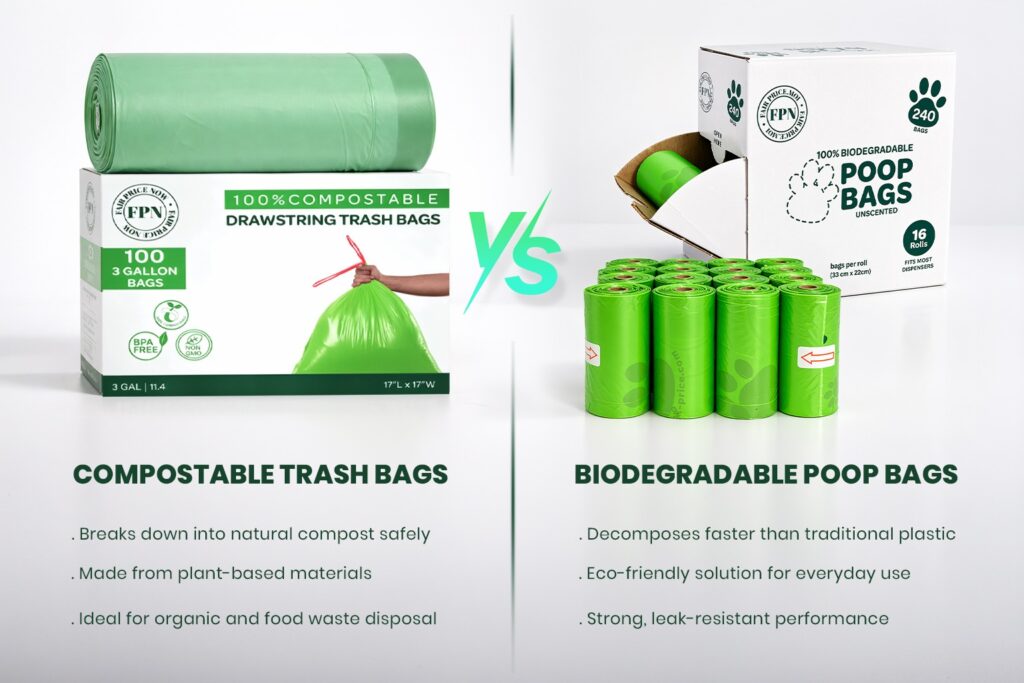
What “Compostable” Means (And Why the Distinction Matters)
Compostable materials, under custom conditions, break down exactly into 3 non-toxic organic matter: Water, Carbon dioxide, and Biomass. And to make that claim legally, manufacturers have to prove it. The most recognised benchmarks are:
- EN 13432 (European standard)
- ASTM D6400 (US standard)
- AS 4736 / AS 5810 (Australian standards, industrial/home composting)
These benchmarks ensure that a material breaks down within 90-180 days, leaves no toxic residue, and supports healthy soil output before it can be called compostable.
For the informed, this is what separates biodegradable from compostable. One describes a process. The other guarantees an outcome and puts a verified standard on it, so no one mimics it. For anyone who needs to justify their environmental choices to clients, donors, regulators, or their own conscience, this makes all the difference.
Read Also on An Eco-Friendly Family Guide to Compostable Bags 2026
Industrial vs Home Composting: The Key Difference Most Buyers Miss
Industrial composting certification on most certified compostable bags implies that they need the heat and controlled microbial environment needed at a commercial composting facility to decompose. Elsewhere, they can either disintegrate gradually or not at all.
A smaller group of compostable bags is home-composting certified, which are capable of breaking down at lower temperatures that can be achieved in a typical domestic environment, so even in cases where you do not have a commercial composting facility that can take pet waste, home-compostable certified poop bags can still be used.
Compostable vs Biodegradable Dog Poop Bags: Direct Comparison
Factor | Biodegradable | Compostable (Certified) |
Certification standard | None required | EN 13432 / ASTM D6400 / AS 4736 |
Breakdown timeframe | Undefined, no requirement | 12–26 weeks under correct conditions |
End product | Varies; may include microplastics | Non-toxic organic matter |
Performs in landfill | No | No |
Performs in home compost | Unlikely | Only if home-compost certified |
Performs in industrial compost | Sometimes | Yes, if certified |
Marketing accountability | Low, self-declared | Higher, third-party verified |
The environmental advantage of compostable bags is real, but only when the disposal infrastructure exists to match. Without access to appropriate composting, the gap between the two narrows considerably in practice.
You may love to read know about Biodegradable Dog Poop Bags
Buying in Bulk? Here’s Why the Difference Really Matters
Buying a single box of 15 bags and getting the choice slightly wrong is a minor inconvenience. Ordering cases of 500 or 1,000 bags, for a shelter, a dog walking service, or a household with multiple large dogs, multiplies the consequence.
Cost efficiency is tied to actual utility
Certified compostable bags typically carry a price premium over standard biodegradable alternatives. At low volume, that gap is marginal. At high volume, you would barely notice.
Greenwashing Risk at Organisational Level
Shelters and pet businesses that promote eco-friendly practices to clients, donors, or the public take on reputational risk when their claims can’t be substantiated or proven.
Durability matters more when you’re using hundreds of bags a week
Compostable may be the right choice, but choose the wrong kind and the choice means nothing. Before you order in volume, check the micron count, verify the certification, request samples, and actually test them.
- Usage environment reality
Compostable bags are certified to break down in industrial composting conditions, offering predictable and verified end-of-life outcomes. Biodegradable bags have no guaranteed or certified breakdown outcome; environmental performance is inconsistent and not reliably verified.
Which One Should You Actually Buy?
The answer depends on what happens after the bag is tied off. Here’s the decision tree that actually maps to reality:
Your Situation | Best Choice | Why |
Access to industrial composting that accepts pet waste | Certified compostable (EN 13432 / ASTM D6400) | Bag breaks down as designed; claim is substantiated by certification |
Backyard compost only, no industrial facility nearby | Home-compost certified only | Industrial-certified bags won’t break down at domestic temps |
No composting access, everything goes to landfill | Biodegradable with known material composition | Compostable bags offer no advantage here; save the premium |
Running a business with public eco commitments | Certified compostable + verified disposal route | Certification is your documentation if claims are ever scrutinised |
Budget is the primary constraint at high volume | Biodegradable | Know what you’re getting; don’t pay a premium for an outcome you can’t achieve |
Avoid any bag that claims to be eco-friendly without specifying a recognised certification standard; uses “biodegradable” as its only credential with no further detail; and cannot confirm material composition or third-party verification.
The Bottom Line: Which Bag Actually Makes Sense?
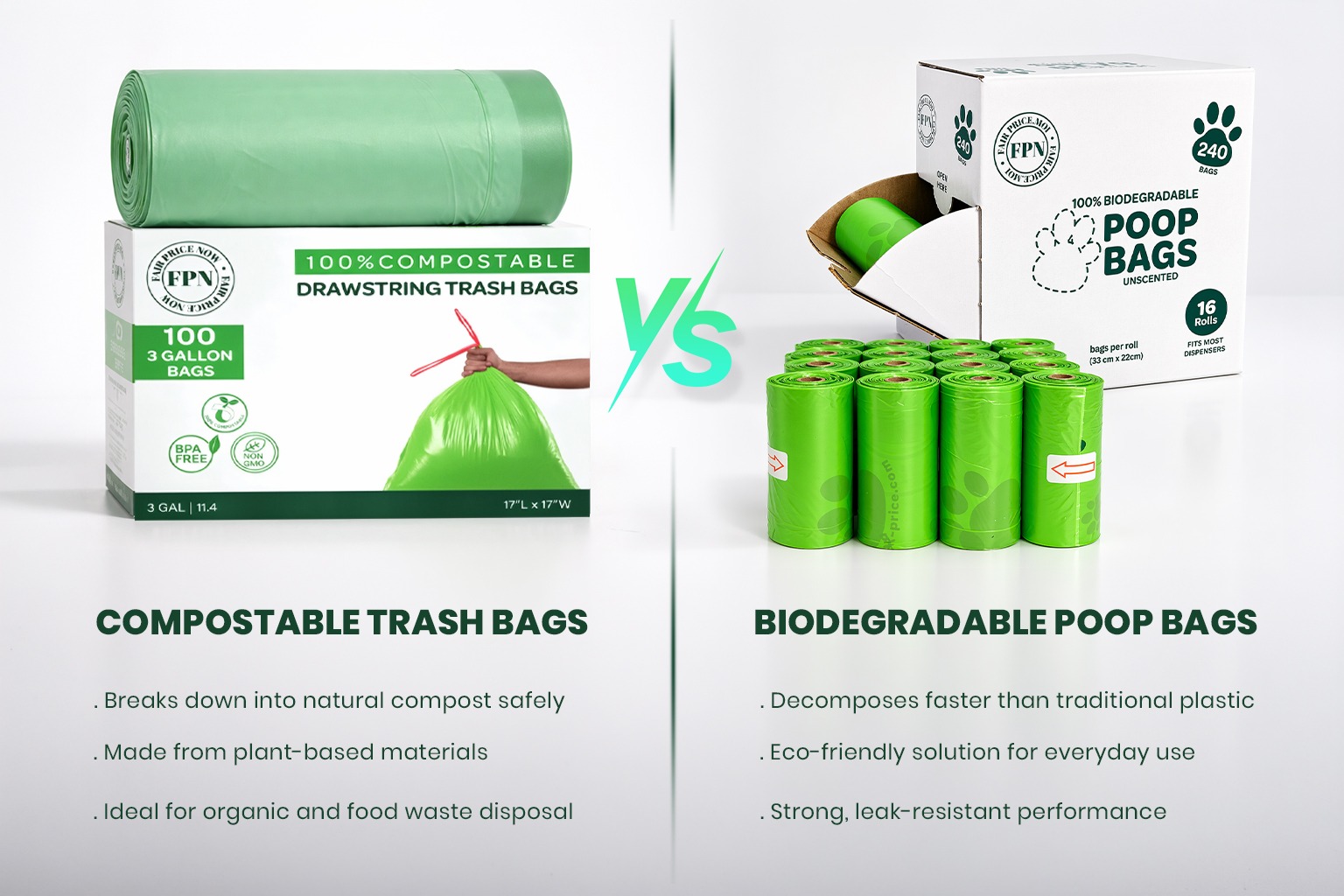
Compostable and biodegradable aren’t interchangeable, even though most packaging treats them as if they are. Certified compostable bags deliver measurable, verifiable environmental benefits when the disposal infrastructure exists to match. Biodegradable bags offer a more ambiguous promise, with performance that varies enormously depending on materials and where they end up, and at scale, uncertainty is risky.
For bulk buyers, the decision is operational. Match the product specification to your actual disposal infrastructure. Verify certifications before committing to volume. Test durability before scaling. The greenest bag isn’t the one with the most prominent leaf icon. It’s the one you buy knowing exactly what it becomes after 90-180 days, and with a system in place that lets it do it.
💰 Looking to cut cost on Eco-Friendly? Get a Free Bulk Pricing Quote + Sample Pack from Bulk-Price today.