One thing packaging won’t tell you is that most “eco-friendly” pet supply claims are just marketing fluff. The term “Biodegradable” can legally mean almost anything; “natural” is unregulated, and “plant-based” does not guarantee that the product performs. However, that’s not a reason to avoid eco-friendly products. Instead, it’s a reason to buy smarter.
This guide skips the lecture and gets straight to decisions: which products are worth buying, what certifications actually mean something, and how bulk purchasing makes eco-friendly supplies cheaper than the conventional stuff you’re buying now. Two dogs, three products, bulk orders: annual savings of $200–$400+. Let’s get into it.
Quick Picks: The Right Eco Pet Supplies for Your Needs
Not sure where to start? This table does the deciding for you.
Your Situation | Best Pick | Why It Wins |
|---|---|---|
Trash goes to regular landfill | Landfill-friendly biodegradable bags | Made to break down in actual landfill conditions. |
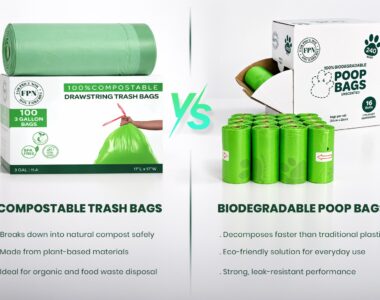
You have home or community compost access | ASTM D6400-certified compostable bags | Fully breaks down in 180 days under real composting |
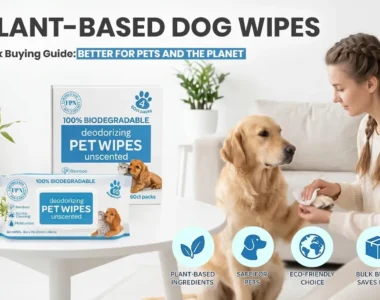
Daily paw wipes, one dog | Thick bamboo wipes, 150-count bulk | Soft, biodegradable, holds up through a full paw wipe-down |
Puppy training, standard output | Plant-based pee pads, cellulose core | On par with conventional for everyday use, and far less waste |
Large breed, heavy overnight use | Conventional SAP-core or hybrid pad | Honest answer: eco pads aren’t there yet for heavy overnight output |
The certification hierarchy that matters: Certified compostable (ASTM D6400 or BPI) > Landfill-friendly > Generic “biodegradable” > No claim. If there’s no third-party verification on the package, treat the eco claim as unverified.
How the Numbers Change When You Buy Pet Supplies in Bulk
Pet supplies cost more at retail. That’s just true, but the premium is almost entirely the packaging margin, not product cost. At bulk quantities, the gap closes fast.
Product | Retail (small pack) | Bulk Order | Annual Savings (2 dogs) |
|---|---|---|---|
$0.10–$0.14/bag | $0.05–$0.07/bag | ~$50–$100 | |
Plant-based pet wipes | $0.25–$0.35/wipe | $0.12–$0.18/wipe | ~$90–$150 |
$0.50–$0.80/pad | $0.25–$0.40/pad | ~$100–$200 |
One bonus nobody talks about is that you never run out. An empty dispenser mid-walk is one of life’s low-stakes but genuinely infuriating moments. Bulk ordering eliminates it entirely.
Browse BulkPrice.com’s pet supplies range to check current bulk pricing, but finish this first so you know exactly what to order.
Poop Bags: What to Check Before You Buy
Two walks a day, one dog: that’s 700+ bags a year. Quality matters more than most people realize until they’ve had a structural failure at the worst possible moment.
Don’t buy anything until you check these deal-breakers:
- Thickness: 15 microns minimum. Cornstarch-blend bags run thin; always check the spec.
- Seam type: Four-sided seal or reinforced gusset bottom. This is where cheap bags fail.
- Tie handles: Sounds minor, but it isn’t, especially at 6am.
- Roll dimensions: Standard 9×13 inch. Verify before ordering 500.
- Certification: ASTM D6400, BPI Certified, or USDA BioPreferred. Anything else, verify before you trust it.
For most people whose trash goes to a regular landfill, landfill-friendly formulations are the practical winner. Certified compostable bags are better in theory, but only useful if you have compost access that accepts pet waste. Most people don’t.
Skip: bags marketed only as “biodegradable” with no certification and no micron spec. That’s most of the cheap options; they’re not a deal, they’re a gamble.
Where Most Pet Supplies Fails (Know This Before You Order)
This section doesn’t exist in most guides. It should.
Pee pads + large breeds overnight: Plant-based cellulose cores perform well for standard training. For a large dog with heavy overnight output, some pads hit their absorption ceiling before morning. The gap is closing with each product generation, but test before bulk-ordering 150 pads.
Wipes + cats: Standard dog wipes often carry fragrance profiles that aren’t safe near a cat’s face or fur. Unscented is mandatory for cats, and check that the formula is explicitly labeled for feline use. What’s fine for a Labrador can cause issues for a Persian.
Generic “plant-based” bags: Some are genuinely better products, while others are cornstarch-colored marketing. The material alone doesn’t guarantee performance, spec, and certification do.
Pee Pads & Wipes: The Simple Buying Guide
Pee Pads — What to Look For
- Cellulose fluff pulp core: renewable, biodegradable, works for most use cases.
- Plant-based top sheet (PLA): breaks down significantly faster than synthetic polypropylene.
- Reduced-plastic backing: look for reduced-plastic, not fully plastic-free claims (most don’t hold up).
- Skip if: the pad has no core material listed and leads with “eco” in the name only.
Pet Wipes — What to Look For
- Bamboo or wood pulp substrate: both biodegrade faster than synthetics; bamboo is softer.
- Aloe vera, vitamin E, and chamomile: standard markers of a quality plant-based formula.
- Hard pass on: DMDM Hydantoin and formaldehyde-releasing preservatives.
- For cats: unscented, always, no exceptions.
Bulk count starting points: Single dog, daily wipes → 150-count canister. Puppy training → 50–100-count pad box to test, then scale. Multi-dog household → 300+ wipes, 150+ pads.
You may want to compare or read an article on compostable vs biodegradable poop bags
Common Myths That Waste Your Money
“Biodegradable means it breaks down fast.” It doesn’t. In a sealed landfill, even certified-compostable bags degrade slowly. “Biodegradable” with no certification just means it breaks down eventually; technically, everything does. This is where most people get misled.
“Eco-friendly means lower quality.” The bad products are bad. The good ones are functionally equivalent to conventional. The difference is knowing how to tell them apart, which is exactly what certifications and specs are for.
“Going green costs more.” At retail, usually yes. In bulk, the per-unit math flips almost entirely. The eco premium is mostly packaging markup, not product cost.
How to Switch to Eco Pet Supplies Without Overbuying
The mistake most people make: replacing everything at once. Something doesn’t work, and they revert. Here’s the version that actually sticks:
- Pick your highest-volume item. That’s poop bags for most dog owners.
- Finish what you have; there’s no need to throw anything away.
- Order a mid-size test quantity: 200–300 bags or a 50-count pad box. Enough to evaluate, not so much that a bad experience stings.
- Set a replenishment trigger: when you open your last roll, place the next order.
That’s the whole system. One item, one transition at a time.
If You Only Read One Section, Read This
Before you order anything, run through this:
- Does the bag have a micron spec and a real certification? If not, skip it.
- Does your trash go to a landfill? Get landfill-friendly, not compostable.
- Are you buying for a cat? Unscented wipes and explicitly feline-labeled products only.
- Large breed, overnight pads? Test a small box first.
- Are you buying small retail packs? You’re paying a packaging premium, not a product premium.
The one call: start with poop bags. Get the spec right. Order in bulk. Most pet owners who make this switch don’t go back, not for environmental reasons, but because the products work and the math actually favors them.
Ready to stock up? https://bulk-price.com/product-category/pet-supplies/
FAQS
Can eco-friendly labels on pet supplies be trusted?
Presume them guilty, until proven otherwise. There is no reliable definition for biodegradable; natural does not necessarily mean friendly, and plant-based only describes a material. The certification on the package is all you can trust.
Is it better to purchase compostable or landfill-friendly bags?
It all depends on where your trash goes. That solution is the traditional landfill in most households, and thus, it is landfill-friendly that wins. Compostable bags are indeed better, but they need a composting plant which takes pet waste.
Are green supplies more expensive?
At retail, yes. However, that premium is primarily packaging markup, not cost of the product. Purchase in large numbers and it is hardly felt.
Is it possible to compost dog poop at home?
The response is a no. Dog waste contains pathogens that cannot be neutralised in a backyard bin. The reason industrial facilities are present is that the high-heat conditions required are impossible at home. When one is by you, make use of it. If not, the regular bin would just have to be adequate.
Do biodegradable bags degrade in landfill?
Landfills are typically sealed and anaerobic, so it is not conducive to the decomposition of biodegradable bags, even certified compostable bags decompose too slowly in this environment. Bags that are landfill friendly are designed differently; their additives work in an anaerobic, microbe-rich environment that a landfill actually offers, but decompose in years instead of centuries.