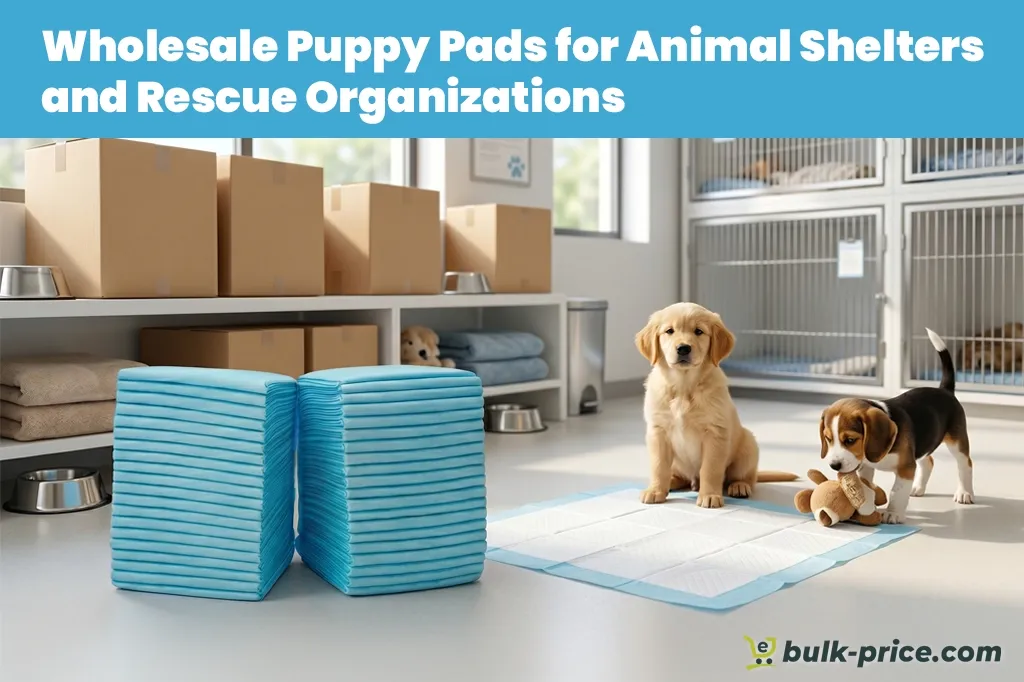
Most rescue organizations don’t think twice about puppy pads until they become a constant problem. One bad bulk order can turn into more cleanup, more laundry, more stressed staff, and more money wasted replacing products that should have worked the first time.
With any shelter, foster network, or animal rescue that operates on a budget, it’s easy to see how the little things can add up. Puppy pads are one of those supplies that seem simple on paper but make a noticeable difference day to day. For most organizations looking for puppy pads for animal shelters, the difference between retail and wholesale puppy pads is operational stability.
The right wholesale option helps keep kennels cleaner, reduces unnecessary labor, and stretches limited resources further. The wrong one usually does the opposite. This is especially true for organizations searching for pee pads for rescue organizations and reliable wholesale pet supplies for NGOs that can scale with unpredictable intake.
This guide breaks down what rescue groups and NGOs should actually look for when buying wholesale puppy pads, how to avoid low-quality bulk products, and how to choose options that hold up in real shelter environments.
Why Shelters Always Seem to Run Out at the Worst Time
Most shelter directors can tell you exactly how many dogs they’re housing. Very few can tell you how many pads they use in a day. That gap, between knowing your animal count and knowing your actual supply consumption, is where budget problems live.
A mid-size facility with 50 to 70 dogs in active care can burn through 300 to 500 pads on a normal day. The facilities that handle this best aren’t the ones with the biggest donation budgets. They’re the ones that stopped treating pad orders as reactive purchases and built a consistent supply line at wholesale pricing.
The difference between ordering 200 pads from a pet store in a panic and maintaining a standing order through a bulk supplier can be $3,000 to $5,000 annually at a mid-size facility, money that ought to go back to vet care, transport, or the next animal you pull.
📦 Browse wholesale puppy pads and bulk pet hygiene supplies at BulkPrice.com
What Separates Shelter-Grade Pads from Cheap Bulk Pads
This is where most puppy pads for shelters fail. A lot of products priced for bulk buyers perform like products priced for individual households, which is to say, badly in high-use environments. Here’s what actually matters when you’re running 400+ pads a week through a shelter:
Absorbency That Handles Full-Sized Dogs
This sounds obvious until you’ve spent a morning reclearing kennels because the pad core gave out at 60% capacity. Multi-layer construction matters. The top sheet needs to wick fast, the polymer core needs to hold volume without spreading laterally, and the base layer needs to actually seal against the floor.
Products that skip the polymer layer, or use minimal amounts, will leak under a large dog. That leak becomes a biohazard cleanup. That cleanup takes time. Time is what shelters don’t have.
Size Range That Covers Your Actual Population
A Chihuahua litter needs a completely different pad than a 90-pound lab recovering from a neuter. Sourcing from a supplier that carries the full range, standard through XXXL, means you’re not overspending on oversized pads for small animals or under-covering large breed kennels.
BulkPrice.com’s dog pee pad collection covers the size spectrum with options built for high-use environments, including extra-large formats for post-surgical recovery and transport crates.
Odor Control That’s Actually Functional
Kennel odor is a staff retention problem as much as it’s a hygiene problem. Visitors to the adoption events can recognize, and volunteers may no longer return. Active charcoal or layers of polymers that neutralize the smell of ammonia do pull the ambient ammonia down significantly, but not to zero, which is what makes the facility smell like a place one would want to go to.
Surface Durability
Tissue-faced pads are a liability in active shelter environments. Dogs scratch them, drag them, bunch them up. A pad that falls apart becomes a choking hazard and an ineffective surface simultaneously. Polypropylene-faced pads hold structure under normal use and don’t disintegrate mid-shift.
The chart below summarizes what to expect at each price point:
Feature | Budget Pads | Mid-Range | Premium |
Layer Count | 2–3 layers | 3–4 layers | 5–6 layers |
Absorbency | Basic / limited | Light to moderate use | Heavy use / large breeds |
Leak-Proof Backing | Inconsistent | Standard | Reinforced |
Odor Control | None | Basic | Activated charcoal |
Surface Material | Tissue-faced (tears) | Moderate durability | Polypropylene-faced |
Best For | Light use / short stays | Average kennel intake | Recovery, transport, large breeds |
Sizing Reference for Shelter Use
Choosing the right mix of dog pee pads wholesale options depends on intake size and housing type. Here’s a practical reference:
Pad Size | Recommended Use | Dog Size |
Small (17×24″) | Puppy litters, kittens, small breed fosters | Under 15 lbs |
Standard (22×23″) | General kennel, adult small breeds | 15–30 lbs |
Large (24×35″) | Mid-size breeds, high-use kennels | 30–60 lbs |
Extra Large (28×36″) | Large breeds, post-surgical recovery | 60–90 lbs |
XXXL / Jumbo | Multi-dog foster homes, transport crates, giant breeds | 90+ lbs or multi-dog |
For most facilities, ordering across two or three size tiers covers the range without overspending. The instinct to standardize on one size to simplify ordering usually costs more in waste and cleanup labor than the purchasing complexity it saves.
Running an Honest Cost Comparison
A lot of shelters switch to wholesale buying after one rough week, which means they never did the math. Understanding how to save money on puppy pads starts with breaking down cost per pad, not per pack. This is where most teams learning how to choose puppy pads for animal shelters start to see real cost differences beyond retail pricing.
Here’s the math:
Cost per Pad, Not Cost per Pack
Divide the total price by pad count. A 100-count at $12 is $0.12/pad. A 500-count at $45 is $0.09/pad. That $0.03 gap sounds small. Across 400 pads a week, it’s $12/week, $624/year. Across 1,000 pads a week, you’re talking about $1,500+ annually in savings from a single line item.
Effective Cost Accounts for Failure Rate
A $0.08 pad that requires double-layering to stop floor leaks isn’t a $0.08 pad. It’s a $0.16 pad with extra cleanup labor attached. This is the part retail-priced comparisons miss. The question isn’t just what does the pad cost; it’s what does the pad cost to use effectively.
Shipping Costs Are Part of the Price
Free shipping thresholds vary. If you’re ordering 300 pads at a time and your supplier charges $18 shipping, that’s an additional $0.06/pad. Verify shipping terms before finalizing any comparison.
The table below shows a realistic weekly cost estimate for a facility housing 60 dogs:
Pad Size | Est. Weekly Usage | Retail/Pad | Wholesale/Pad | Weekly Savings |
Standard (17×24″) | 150 pads | $0.25 | $0.12 | $19.50 |
Large (24×36″) | 200 pads | $0.45 | $0.22 | $46.00 |
XL / XXXL | 100 pads | $0.70 | $0.38 | $32.00 |
Weekly Total | 450 pads | ~$175.00 | ~$78.00 | ~$97/week |
Annualized, that’s over $5,000 in savings on pads alone at a single facility. Most shelters are leaving that money on the table because nobody has time to audit the supply budget between intake waves.
Storage: The Part That Kills Bulk Buying for Some Facilities
Buying in volume only works if you have somewhere to put it. This sounds obvious, but a lot of shelters get burned by it. A few straightforward practices prevent this:
- Store pads in the original packs until they are used. Most people do not realize moisture and dust will cause the absorbent core to become degraded.
- Stack no more than four or five cases high. Excessive weight compresses the layers and reduces absorbency in the bottom cases.
- Store away from cleaning chemicals. Chemical fumes affect pad performance and can leave residue that irritates animals.
- Rotate on first-in, first-out. Old stock sitting untouched while new inventory gets opened is an easy waste source.
- Set a reorder trigger at two weeks of supply, not when you run out. If shelters are close to their consumption limits, they can avoid the scramble that has cost implications by keeping a stock line standing.
FAQs
Where can shelters find affordable puppy pads in bulk?
Wholesale suppliers like BulkPrice.com offer volume pricing across multiple sizes with no minimum order requirement. Unlike retail chains, pricing scales with quantity, so you pay less.
How many puppy pads should a shelter realistically keep in stock?
Most mid-size shelters should maintain at least 10–14 days of supply on hand based on average intake volume. Facilities with fluctuating intake should lean closer to 21 days to avoid emergency ordering cycles, especially during high-intake seasons.
What features matter most for shelter environments?
Multi-layer construction with a proper polymer core, a reinforced leak-proof base, and polypropylene facing. Odor control is secondary but meaningful for staff and visitor experience. For high-turnover kennels, check out the pet hygiene supply range to compare performance options across size and absorbency tiers.
Can shelters use the same pads for cats?
Dog pads work in a pinch, but purpose-built options are better. BulkPrice.com also carries dedicated cat pee pads with sizing and odor control formulated for feline use. For mixed-species facilities, species-appropriate options prevent litter box aversion issues.
What’s the most common mistake shelters make when buying puppy pads?
The biggest mistake is treating pad purchases as reactive rather than scheduled procurement. This leads to inconsistent quality, emergency retail buying, and hidden annual overspending that often goes unnoticed in budget reports.
Every dollar saved on consumables is a dollar that goes back to the animals.
BulkPrice.com’s wholesale pet supply catalog is built for organizations that need reliable product and transparent pricing without supplier complexity. Start with your dog pee pads, add pet wipes, biodegradable poop bags, and compostable trash bags, all in one order, all at wholesale rates.
📦 Shop Wholesale Puppy Pads and Bulk Pet Supplies at BulkPrice.com →