Why Cheap Dog Poop Bags Rip Mid-Walk (And How to Avoid the Mess)
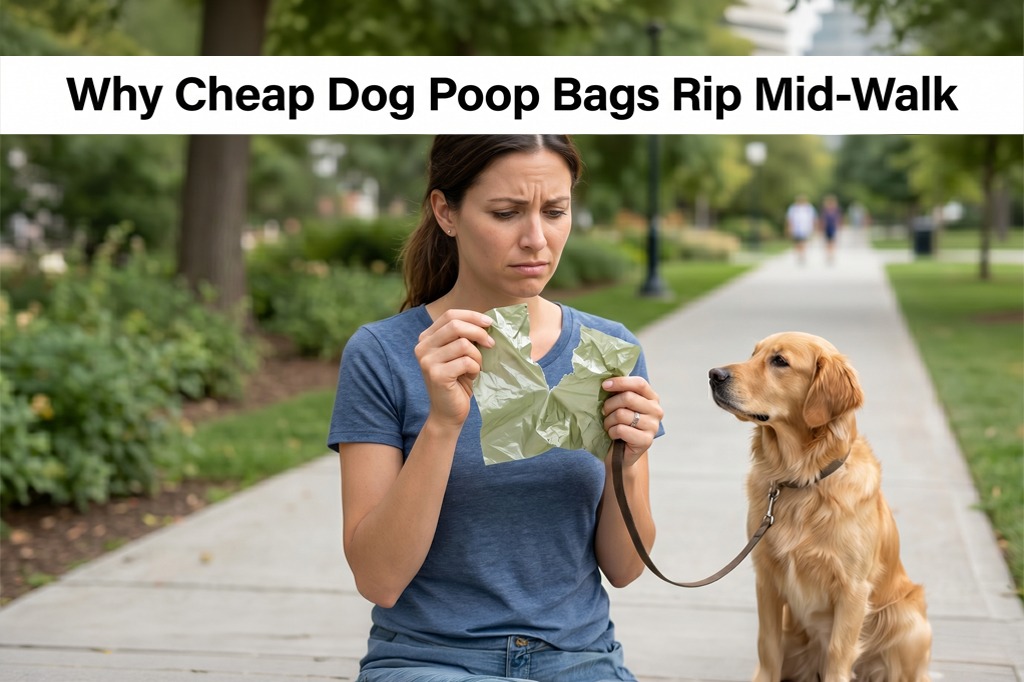
Anyone who’s had a poop bag give out mid-pickup knows it’s one of those small disasters that ruins an otherwise pleasant morning. There’s the mess, obviously, but there’s also the slight panic of standing on a sidewalk with nothing but a torn plastic bag and a problem that’s now worse than it was thirty seconds ago.
We hear about this a lot from customers, people who switch to BulkPrice.com’s dog poop bags after exactly one bad incident with a bargain brand. So let’s actually talk about what separates a bag that holds from one that doesn’t, because the answer is more specific than “buy the expensive one.”
Why Some Dog Poop Bags Hold Up, and Others Fall Apart
Three things determine whether a poop bag survives contact with actual dog waste: the thickness of the plastic, the quality of that plastic, and how the bottom seam is made. That’s it. Everything else is packaging.
Thickness is measured in microns, and most of the bags sitting on dollar-store shelves come in around 10 to 12 microns. That’s thin. Thin enough that a stick, a sharp piece of gravel, or just the wrong angle of your hand can punch straight through. Bump that up to 15 microns, and you’ve got a meaningfully sturdier bag. Get to 18 or 20 microns, which is where we’d point anyone with a large dog, and you’re carrying something that can actually take a hit.
Plastic quality is the part almost nobody talks about, and it’s arguably more important than the micron number. A 15-micron bag made from solid LLDPE will often outlast a 20-micron bag made from cheap recycled material. We’ve seen this firsthand; a bag that feels reasonably thick in your hand but tears the second it’s stretched. That’s a material problem, and it’s exactly the kind of thing a spec sheet won’t tell you.
Seam construction is the third piece, and it’s the one that usually fails. Cheap bags are usually glued or lightly heat-sealed along the bottom, fine for an empty bag,but useless once there’s weight pulling on it. A star-sealed bottom spreads that weight across a wider area instead of concentrating it on one seam line.
The Same Mistakes We See Dog Owners Make Again and Again
After years of selling these in bulk, a pattern shows up. People don’t usually fail because they bought a bad bag on purpose; they fail because nobody told them what to look for, so they default to whatever’s cheapest or whatever’s on the shelf at checkout.
A few mistakes come up constantly:
- Buying based on bag count instead of bag quality. A box of 300 thin bags sounds like a better deal than a box of 150 solid ones, until you do the actual math on how many you’ll throw away half-used because they split.
- Assuming “biodegradable” means “weaker.” It doesn’t have to. But a lot of cheap biodegradable bags are thin on top of being plant-based, which stacks two weaknesses on top of each other.
- Not adjusting for dog size. A bag that’s perfectly fine for a 12-pound terrier is asking for trouble with a 90-pound Lab. Waste volume and density scale with the dog, and the bag needs to scale with it, too.
- Ripping bags off the roll aggressively. This sounds minor, but a rough tear along the perforation can create a micro-tear that runs the second the bag takes any load. Pull gently. It matters more than people expect.
What Most Dog Owners Forget When Comparing Prices
Bulk dog poop bags get marketed entirely on price per roll, which is the wrong number to look at. The number that matters is cost per successful pickup.
Say you’re comparing two options. A cheap roll that runs about $5 for 200 bags, and a quality roll that runs $11 for 200. On paper, the cheap roll wins easily. Now factor in the failure rate. Thin, low-grade bags fail, tear, leak, or need doubling up, somewhere around 15 to 20% of the time, based on what we consistently hear from customers managing multiple dogs or running pet care services.
Quality bags fail closer to 1 to 2% of the time. Run those numbers across 200 bags, and the cheap roll’s real cost per successful pickup creeps up, while the quality roll barely moves. Add in the actual cost of a failure, the cleanup, the wasted second bag, the occasional ruined pair of gloves, and the quality bag usually wins outright.
This is the same logic that applies to stocking up through BulkPrice.com instead of buying whatever’s cheapest at a given moment: bulk only saves money if the product actually performs at volume.
Signs a Bag Is Low Quality Before You’ve Even Used It
You can usually tell a weak bag before it ever meets a pile of waste if you know what to check.
- Hold it up to the light. If you can see clearly through it without stretching, it’s thin, full stop. Quality bags have a slight opacity even when unstretched.
- Look at the bottom seam in product photos. A flat glued line is a warning sign. A gathered, star-shaped seam is a good one.
- Smell matters too. A strong chemical or plastic odor right out of the package often points to lower-grade recycled material.
- Stretch a corner gently between two fingers before you ever use it for its actual job. If it feels papery or gives way with light pressure, that’s your answer.
FAQs
Why do my dog poop bags keep tearing?
Almost always thickness, plastic quality, or seam construction, usually some combination of the three. Bags under 12 microns with glued bottoms are the most common culprits, especially with larger dogs or firmer waste.
Are thicker poop bags always stronger?
Not necessarily. Thickness matters, but so does the grade of plastic. A thinner bag made from quality material can outperform a thicker bag made from low-grade recycled material.
Why does my poop bag dispenser keep running out so fast?
Usually, because failed bags are getting doubled up or thrown away unused, which burns through a roll much faster than expected. Switching to a more reliable bag often solves the “running out too fast” problem on its own.
Do poop bags actually break down in landfills?
Rarely, and not quickly. Even certified compostable bags need industrial composting conditions to break down within months, most municipal trash systems still send everything to landfill, where breakdown can take years, regardless of the label.
How many poop bags should I buy at once?
For a dog walked twice a day, plan on roughly 60 to 90 bags a month. Most people who manage multiple dogs or run pet care services buy in bulk, rolls of 200 or more, both for cost and so they’re not restocking constantly.
Cut your pet supply expenses without sacrificing quality? Check out our poop bags at Bulk-Price today. Show your love for your pet even more!